Your recent collaborations with Aleksandra Waliszewska and Zbiok Czajkowski connect closely with SWARM MAG’s Collective Currents theme, which focuses on cooperation and shared ideas. Why did you choose to collaborate with them? What did you feel in their work that made you want to work together?
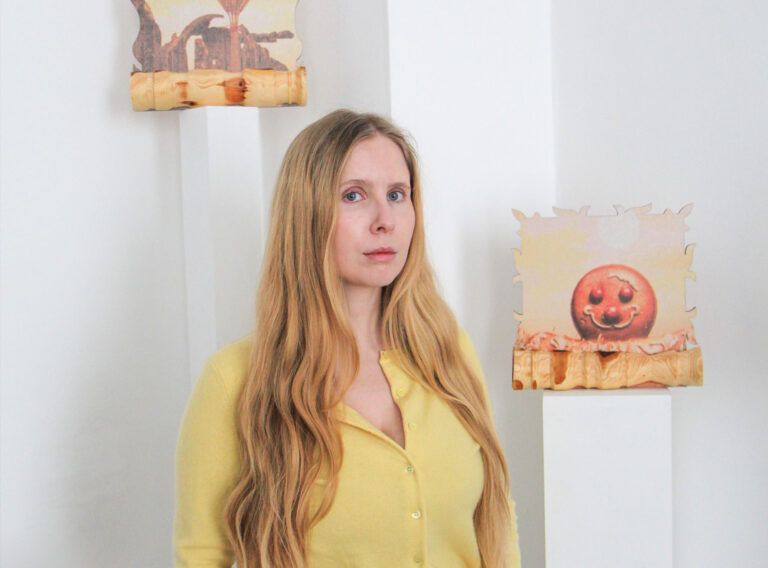
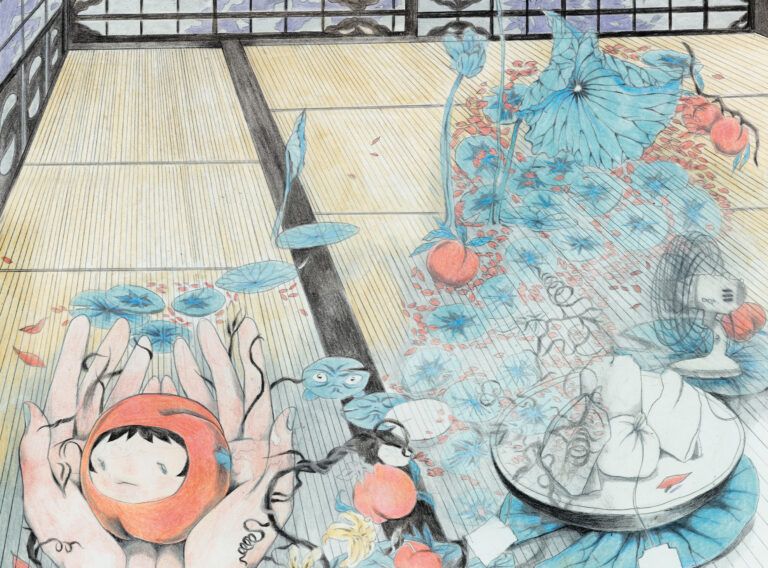
I deeply admire both of these artists. Aleksandra has been my favourite painter since my student years. I am in love with the world she creates through her paintings. Aleksandras’s work is an endless ocean of possibilities when it comes to building narratives, and her sensitivity in creating her own universe is both beautiful and dark. One day, we wrote to each other about a potential collaboration, and after the first collection, it became clear that our creative worlds aligned – something that was only confirmed by our second joint collection.
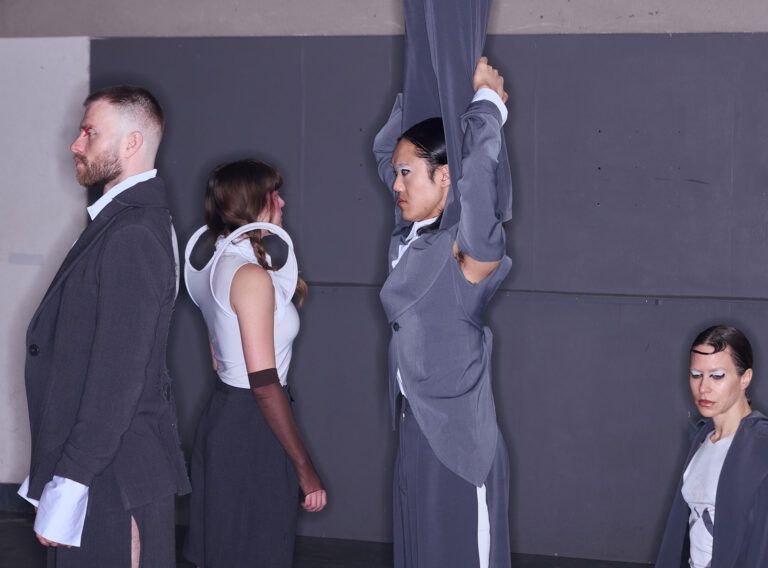
I love Zbiok for his dark universe, torn straight out of a nightclub, existing somewhere on the border between dream and reality. You are never fully sure whether what you see is real or just a projection of your own mind. Zbiok is an extraordinary artist; when you look at his work, you feel like it is about to swallow you whole. It is that immersive.
Both artists work with darkness, unease, and the subconscious.
How do these themes translate differently when they are expressed through garments rather than through paintings or visual art?
When I translate these themes into garments, they become more physical and intimate. Clothing enters your personal space and, in a way, becomes part of you. It touches the body, moves with you, breathes. I love the moment when I see how the look changes once I dress the collection with works by Aleksandra or Zbiok. I feel that I help bring their art closer to the wearer, giving painting and graphic works a different space to be felt, not only seen.
It allows you to live with them on a daily basis. In a way, I turn them into a “second skin”, one that starts to live with the stories contained in the artists’ paintings, carrying them through movement, time, and the body.
Did working with these artists change the way you think about fashion as something temporary, in contrast to art, which is often seen as more permanent?
Since I started working in fashion, I have always wanted it to be something more than just clothing. I wanted it to be universal and not follow seasons. That was always what troubled me most about the fashion industry – its temporary nature, trends, the speed. At the same time, I was afraid that with this approach, there would be no place for my brand. After my recent collaborations, I feel that many of my decisions finally make sense, and that the audience truly appreciates this sustainable way of thinking. I am happy to see that more and more clients are willing to wait a little longer for production, knowing that, in return, they receive something made locally by a wonderful seamstress, and combined with the art of such outstanding artists.
How do you work with colour, textiles, and silhouettes when creating a collection? In your collaborations, the palette often feels organic but also slightly otherworldly. How do these visual qualities shape the final garments?
A big part of this process is the story I want to tell through the collection. When working with Aleksandra, I wanted to speak about what awakens when everyone else falls asleep. I am deeply inspired by the atmosphere of uncertainty, unease, darkness, and what hides behind it. It is a story about a long night, about everything that disappears during the day and only comes out after dusk. This is where the palette and the selection of Aleksandra’s works came from. Once I know what I want to tell and which world I want to invite the viewer into, colours, textiles, and silhouettes begin to appear quite naturally. I truly love this moment of the process.
With Zbiok’s collection, it was very important for me to show tension. The main inspiration came from David Lynch’s films, especially Mulholland Drive. I wanted the collection to echo the relationship between Betty and Rita, often framed against darkness so soft and velvety it feels like a hovering nimbus, ready to swallow them if they wake from the film’s dream. And when they are swallowed, when smoke fills the frame as if the sulphur of hell itself were obscuring our vision, we feel that it is not only a romance that has been broken, but that the beauty of the world itself has been cursed. This was beautifully captured in words by Charles Taylor in his text on the nostalgia of love in David Lynch’s films.
And as a final question, taken from the description of your collection: What comes to life when we all go to sleep?
When we all go to sleep, what comes to life is everything that has to stay silent during the day. Fears, desires, images we don’t have words for. At night, they no longer have to pretend; they can simply exist. It is the moment when the world becomes more honest, and the line between what is real and what is imagined slowly disappears. Night is what the day keeps hidden in its shadows.
Pat Guzik lives and creates in Kraków, Poland. She graduated from the faculties of Philosophy and Fashion Design. Her diploma collection was awarded with a 6-month scholarship in Escuela de Diseño y Alta Costura in Valencia. She showed her collection in Riga (Habitus Bajtija), Hannover (Fashion Finals), Budapest (Central European Fashion Days), Hong Kong (Hong Kong Fashion Week, CenterStage Asia’s Fashion Spotlight), Vancouver (Vancouver Fashion Week), London Fashion Week (Fashion Scout), Shenzen Fashion Week (Sustainable Fashion part), Galeries Lafayette (Shanghai), Harvey Nichols (Hong Kong) and M+Booth in M+Museum (Hong Kong). Guzik is the winner of the Redress Design Award 15/16 and also obtained a special prize for collaboration with Janet Ma (organised by Redress Asia, Hong Kong). In 2017, she won the Best Formal/Couture Fashion Label award at The Eluxe Awards 2017 (Sustainable Luxury Awards) in Los Angeles.
Fashion designer / Pat Guzik @pat_guzik
Interview / Kateřina Hynková @khynko