AS LONG AS IT VIBRATES

French painter and illustrator Sébastien Pastor navigates between naïve figuration and abstract expressionism, building visual worlds where bold color palettes pulse with rhythm and absurdity. Discover how his colorblindness became a creative signature and how he leaves room for the enigmatic in his works.

Your visual universe feels like a crossroads between comic art, psychedelia, and pure emotion. When you start a piece – whether a painting or illustration – do you approach it more as a designer or as a storyteller?

It depends on the practice, but I would say my approach is closer to that of a designer. For me, whether in illustration or in painting, the notion of rhythm within the frame is essential – through shapes, colors, and composition.

Narration plays a bigger role in my illustration work, which is highly figurative, naïve, and close to the world of comics. For a while, I produced a series of comic strips where telling deeply absurd stories was the central idea.

Today, I am transitioning from illustration to painting, where I have discovered a different approach, another form of writing – something far more abstract. Here, there is no message or story being explicitly delivered. Inventing a narrative can help me as I shape a painting, but I prefer not to reveal it. I keep it to myself and try to blur the tracks. I like leaving room for the enigmatic, for something more diffuse – an open space where the viewer can immerse themselves and imagine their own story, their own intimate interpretation.

Color plays a major role in your work. What’s your process for building a palette? Do you chase harmony, conflict, or instinct?

It’s true that color plays a central role in my work. I see it almost as a signature in my visuals. Even though I’m far from the only one – bold, flashy colors have been widely used in illustration and advertising for several years now.

However, being colorblind, I think I have a very intimate relationship with this kind of chromatic range. I’m naturally drawn to images or artworks where colors vibrate intensely against one another.

To build a palette, I draw from many references and image sources – illustrations or graphic design from the 60s and 70s, paintings, even film stills, and more. I’d say my choices lean toward overall harmony. Still, there is always a part of instinct, and my perception as a colorblind person sometimes leads me to choose colors that clash slightly with the rest of the palette. Colors I often can’t even identify: “Is this blue, purple, grey?” It doesn’t matter, as long as it vibrates.

Your paintings feel more fluid and expressive, while your illustrations have graphic precision and humor. How do these two practices feed or contradict each other?

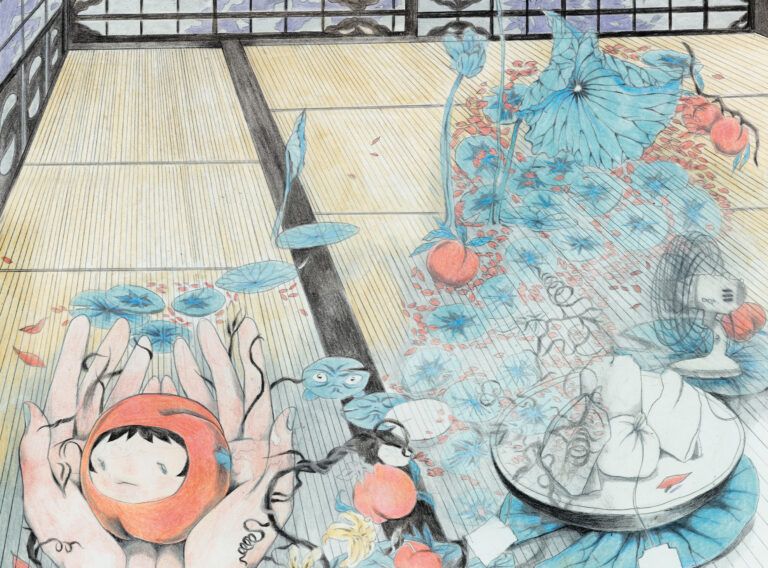
I could say that these two practices function as mirrored opposites. My illustrations are figurative and very straightforward – you understand what you’re looking at. The treatment is naïve, colorful, and the tone is humorous and absurd. The reading keys are clear.

My paintings have a similar candor and colorfulness, and even though they remain closely linked to figuration, their underlying structure is far more abstract. Here, humor disappears, but absurdity becomes a more subtle, underlying element. The space opens up to the enigmatic, the strange, and to the viewer’s own perception.

Many of your works reference music imagery and culture. How does sound influence your visual thinking?

Working with music puts you in a particular state – a certain energy. I think the influence isn’t tangible in a direct way; it’s more unconscious. There’s something quite magical about that. It’s the extraordinary power of music, and of art in general – something that revitalizes you, enters your body, and sends back a surge of vital force.

There’s joy and playfulness in your characters, but also something surreal, even absurd. What role does humor play in your artistic language?

It’s a small engine in my illustration work. It gives me ideas to start creating. I enjoy mixing absurd humor – sometimes even silly humor – with the very naïve visual language of my work. It’s my way of evoking the absurdity of the world.

I always try to integrate it, even in more serious professional projects, though that can sometimes be difficult.

Your paintings, though abstract, seem charged with emotion, as if something internal leaks into shape and color. Do you see them as emotional landscapes?

I conceive my pictorial work as a space where textures and forms coexist and converse freely. Through layers of material and the vibration of colors, each composition plays with contrasts. The framing is tight, and these chosen viewpoints question the intimate, the off-screen, the infinitely large, and the infinitely small.

They are like mental landscapes, a kind of strange, chaotic puzzle where colors are in constant vibration. I like the idea of giving the viewer the keys – of making them active, placing their perception at the center.

Also many of your illustrations reinterpret iconic music imagery. What draws you to revisiting cultural icons?

I’ve been fascinated by the visual world of music since I was a child. I love the idea of placing myself at the service of an artwork that isn’t visual. It’s one of the aspects of illustration that I enjoy the most – something I always wanted to do.

When I started working as a freelancer, I had the idea to reinterpret album covers I loved in my developing illustration style – as a sort of visual remix. It was a way to train myself daily. I liked the idea of paying homage to works that mattered to me, that shaped me.

Beyond that, I also had a small strategy in mind: posting these “drawmixes” on social media could be a good way to get noticed, especially by musicians. Very quickly, it helped me gain momentum, work on my first record covers, and connect with artists. With hindsight, that series of reinterpretations made me discover a huge number of visual and musical artists. It allowed my practice to evolve – illustration after illustration. I stopped this project some time ago, after more than 400 reinterpretations.

Is there someone – artist, musician, etc. – you would love to collaborate with?

It’s very hard to choose; there are so many. I’ll stick to two, even though it’s really not easy. First, I would say the Ed Banger Records label. It’s been a dream of mine since I was a teenager. The work of So Me, the label’s graphic designer, has been a major reference for me since I was young. It’s a real checkbox on my list.

And second, Carlos Santana. His music means a lot to me, and I love the graphic and chromatic universe surrounding his album art. Working with him would be a waking dream.

Did you like it?
Share it with your friends

Bio

Sébastien Pastor is a French painter and illustrator born in Montpellier. His work moves between two practices: an illustrated figurative universe rooted in naïve expression and absurd humor, and a more expressionist, enigmatic form of abstract painting. In both, a shared grammar emerges – rhythmic framing, graphic precision, and bold colors where vibration is central.

His colorblindness has become an unexpected creative asset, drawing him toward palettes where hues clash and pulse against one another. Over the course of his career, he has created more than 400 “drawmixes” – visual reinterpretations of iconic album covers – connecting him with musicians and evolving his practice illustration by illustration.

Credits

Art / Sébastien Pastor @sebastienpastorr @jeune_woof
https://www.sebastienpastor.com/
Interview / Markéta Kosinová

You may also like

“It is a story about a long night, about everything that disappears during the day and only comes out after dusk.” Polish fashion designer Pat Guzik breathes new life into her garments by collaborating with visual artists, such as Aleksandra Waliszewska and Zbiok Czajkowski, whose dreamy and tongue-in-cheek works adorn the skirts, sweatshirts, jackets, and other ready-to-wear pieces by the designer.
Spanish illustrator Laura Mestre transforms emotional overflow into tender visual poetry, using symbols of water, flowers, and cracks to map the quiet beauty hidden within difficult experiences. Discover how metamorphosis, instinct, and a fanzine called "Hay que volver" helped her reclaim drawing as both refuge and release.
In my last year’s review, I wrote that some part of me wished to keep PAF jealously to myself. Either that wish has not been intercepted in the ether or has been twisted completely because the 2025 edition of PAF, Festival of Film Animation and Contemporary Art in Olomouc, Czechia, was bursting at the seams; again. However, it’s one of the Czech festivals that deserves to be sold out and a bit cramped, and I’ll tell you why.
Czech painter Lukáš Šmejkal traces the unstable boundary between body and terrain, composing lyrical visual assemblages where electric pylons become threads and human figures dissolve into the landscapes they inhabit. Discover how photography, movement, and Baroque verticality shape his meditations on perception in today's interview.