Your illustrations often emerge from moments of emotional overflow. What role does drawing play in helping you process or reinterpret these experiences?
I’ve always had trouble processing and understanding my emotions, and also expressing them. As I grew older, I became aware of how important it is to understand and move through them, but at first, putting certain feelings into words was hard for me. That’s when I started using drawing and writing as tools to communicate what I was going through – first with myself, and later with others.
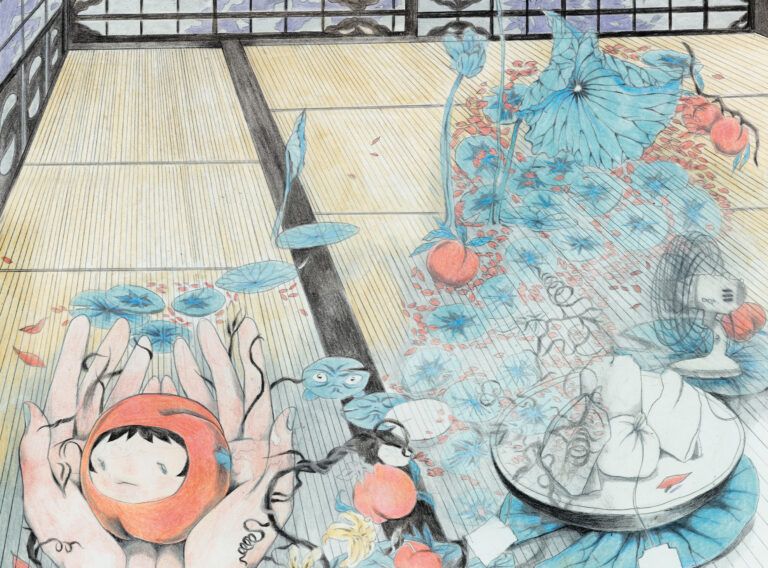
You’ve mentioned using symbols like water, flowers, cracks, and stars – each carrying a private mythology of regeneration, memory, and transformation. How did these visual “words” evolve within your language of imagery?
They emerged quite organically, and I still hold on to much of that symbolism because these are universal elements that exist in everyone’s imagination, regardless of the specific meaning I might assign to them. I think that allows each person to give their own meaning to the work and connect with each illustration in a personal way.
There’s a tenderness in how you approach difficult emotions. Is there some kind of connecting theme or approach within your work?
I suppose the common thread is my own way of thinking and my tendency to rationalize my experiences. There’s always a kind of intense melancholy, but there’s also the part where I recognize that something that once hurt you doesn’t necessarily have to be bad.
And often there’s an intention to look for another perspective that’s more aligned with the aesthetic side: the act of turning a negative episode into a beautiful illustration you’d want to hang on your bedroom wall, for example.
You move between illustration, comics, and design, also between introspection and collaboration. How do you balance the personal intimacy of self-publishing with the collective rhythm of working for a publishing house or brand content?
For a long time, it was difficult for me because I felt that my work was a reflection of who I was as a person. What began as a tool to understand and communicate with myself eventually became a source of creative block, as I started to have more expectations, more filters, and ultimately more constraints. I even stopped drawing for a while, until in 2024 I made a fanzine called “Hay que volver” to break that pattern.
I’d say that now I’m able to distinguish between the different types of projects I take on – the more personal ones and those that aren’t. I just try to maintain my essence without that added pressure.
The worlds in your visual narratives feel like meditations on change – bodies morph into petals, thoughts take root, and everything seems to breathe in slow rhythm. What draws you to the idea of metamorphosis as both a visual and emotional language?
Visually, metamorphosis as a concept is a lot of fun because it allows you to merge shapes, bodies, colours, and more. It’s a resource I use often when I work on animations, for example.
Emotionally, it helps me deal with my resistance to change and to accept that it’s the natural process of all things – including myself – and that change and evolution are actually very positive things.
The gradient tones you use – soft pinks, violets, blues – seem to evoke not just light, but emotion itself. How do you approach colour as a storytelling force?
I don’t rely on the psychological connotation or cultural meaning of each colour; I use them in a very instinctive way. Sometimes in a semi-realistic manner, and other times purely based on personal taste and intuition. But I do try to make sure that the colour palette I use evokes what I’m trying to express.
Text and image flow together like a single breath in your work. Do you begin with words that blossom into images, or do visuals lead the way toward language?
Usually – I think because of a certain mental rigidity – I start with the text. I need to be clear about what I’m going to communicate, how it makes me feel, and the tone I want to use. Then I figure out the best way to translate that into drawing so that everything makes sense together. However, there are always times when it happens the other way around.
Your zines and comics feel deeply personal yet universally resonant. How do you navigate the balance between confession and symbolism?
They’re personal because in most cases I speak from my own experiences and communicate them from my own perspective, but that doesn’t mean they’re unique or special. I don’t have the belief or the feeling that I have something important to say or teach the world – that would feel pretentious and unrealistic to me.
I think it’s completely normal that people might relate to what I do because we’ve probably lived through similar experiences or share the same wounds.
In our recent theme we’re focusing on collaborative work. Is there any collaboration that you would like to mention? Also, is there some collaborative work that you’ve dreamt about?
Yes, in 2023 I collaborated with the British band The Bees, creating the music video for their song “Punchbag,” and to this day it’s still one of my favourite collaborations. As for a dream collaboration, I’ve always loved the idea of illustrating a scarf for Hermès. On the other hand, I’m passionate about music and would love to collaborate more often with other bands.