About the collection LADO BOKUCHAVA — SPRING / SUMMER 2026
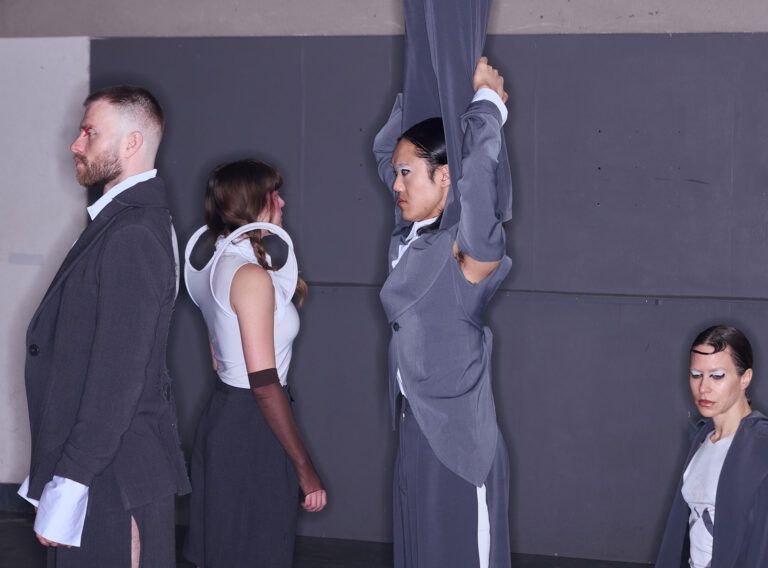
For the Spring/Summer 2026 season, LADO BOKUCHAVA presents a womenswear collection inspired by the visual tension of horror cinema and the gothic subculture of the 1980s. The collection reinterprets the language of classic eveningwear through deconstruction, exploring the contrast between sophistication and unease, elegance and distortion. The silhouettes embody a dialogue between control and release, where precise tailoring intersects with elements of disruption. Iconic forms of femininity are reframed with a modern sensibility — revealing strength through vulnerability and refinement through imperfection. Continuing the brand’s commitment to conceptual design and contemporary femininity, the Spring/Summer 2026 collection reinforces LADO BOKUCHAVA’s signature aesthetic — intellectual, architectural, and emotionally charged.
Your Spring/Summer 2026 collection draws from the visual tension of horror cinema and the gothic subculture of the 1980s. What attracted you to this specific intersection of fear and beauty as a foundation for your work?
People’s perception of horror is that it causes fear, but, at the same time, this fear is attractive. I tried to find beauty in darkness and fear. Gothic subculture is dark and unattractive as well, but, at the same time, beauty can be found in this darkness. Finding beauty in fear and darkness is very inspiring for me.
Is there one film from that era you would recommend as the best companion to this collection for our readers?
Possession by Andrzej Żuławski.
What does contemporary femininity mean to you today, and how does this definition shape your design language?
As there is no specific definition, style or visual of femininity for me, many things can be perceived as feminine. I think that in today’s world, femininity is a wide range of things with no specific characteristics. So it is more interesting for me to find femininity in more unusual things.
In our present theme, Collective Currents, we look at the creators shaping the cultural flow between regions, cities, and generations. How does this idea resonate with you as a designer rooted in Tbilisi yet connected to the wider European scene? And what energy or vision would you like your work to carry forward into our shared fashion ecosystem?
Collective Currents resonates with me because my work naturally lives between Tbilisi’s emotional, raw and creative energy and the structure and perspective I get from the European scene. The vision I want to bring to our shared fashion ecosystem is clarity and strength – redefining femininity through sharp, confident silhouettes that carry both protection and power.
And last question, is there a question about your work that no one has ever asked, but you wish they would?
I don’t really like looking at something from one side only and talking only about my personal views, so I want society to have its own idea and perception of my work.