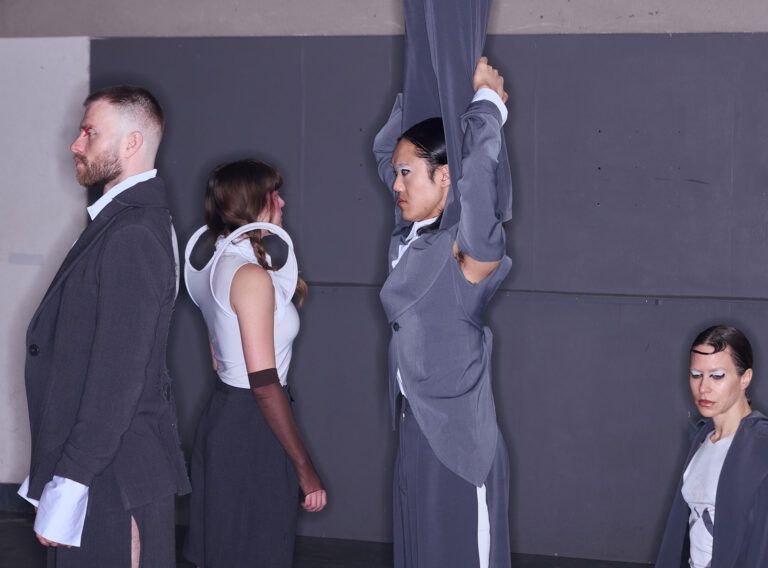
Marlena Krawczyk’s REMEMBER collection stems from a physical place that, as she claims, has “taken root in her psyche”. The Polish fashion designer uses materials and porcelain-doll-like silhouettes that are meant to evoke the spirit of childhood spent in her grandparents’ home – a bit of a sensory journey to the nostalgia-tinged past. Plunge deeper in the interview below.
Poland is a land of deep traditions. As a Polish designer, how does your work navigate between honouring heritage and challenging it?
As a designer, I try to find a balance between respect for Polish tradition and the desire to introduce new, bold solutions. Poland has many unique traditions that are a great base for creation. My works are often based on simple, classic forms, but I introduce modern elements to them. I try to respect our roots, but at the same time look to the future. In my collection, I created bags covered with silver spray that have rounded handles made of wood. The shiny surface of the bags refers to the ritual of setting the table. The silver trays that were the inspiration for creating the bags are a symbol of cultivating family traditions for me.
What’s your relationship with the materials you work with – do they dictate the design or do you bend them to your vision of the collection?
The clothing collection is an attempt to capture moments from my family home. Clothes are carriers of meanings and emotions. Through the selection of materials, I want to evoke specific memories. Each of the nine silhouettes is a different story that is connected to my grandparents’ home. The materials are adapted to the vision of the collection. Wool coats remind me of my grandfather’s wardrobe and add a winter character. I wanted the materials to reflect the atmosphere of the interior of the house, which is why, in the collection, I used materials that surrounded me in my childhood – wool, lace, furniture fabrics.
What inspires you more: beauty in imperfection or pursuing perfection?
The REMEMBER collection is a record of the atmosphere of a house that has undergone changes. I remember the ticking of an old clock or a rough wooden floor. All the imperfections of the house, dirt or damage, are a set of sensory experiences that have taken root in my psyche and are the source of inspiration for my collection.
How important is traditional craftsmanship in your practice, and how do you balance it with innovative techniques?
In the collection, I use handmade lace napkins. Most of them I acquired second-hand or from older people in my family. Drawing from my family heritage, I create a foundation for further exploration. By combining traditional craftsmanship with modernity, I can establish a dialogue between generations. Drawing inspiration from traditional patterns, I create modern interpretations that respond to contemporary trends.
Last one: What happens to your pieces after they leave your hands and become part of someone else’s story?
When I finish working on a collection, I think about how the photoshoot will look like and I often notice new interpretations. I am happy when I see a smile on the faces of people who wear my clothes.
Did you like it?
Share it with your friends
Bio
Marlena Krawczyk is a clothing and fabric designer. She gained her experience while studying at the Academy of Fine Arts in Łódź. She completed her first and second-degree studies in Fashion Design. She received the Rector’s scholarship for achievements twice. In 2023, she took 2nd place in the Radom Fashion Show competition and her work was presented in French magazines, including Fienfh, Penida Magazine, and the British Seedlings Studio. She participated in shows at Off Fashion and Routes Europe 2023.
“I crave the complicated because it entertains my brain.” At the 2026 Lunchmeat Festival, nan Cifra (the newest nom de plume of composer and musician Natálie Pleváková) will present her performance Tangled in Narratives, playing material from her debut album.
French and Belgian artist Léa Porré excavates relics of our collective memory, translating her digital worlds into forged steel, jacquard tapestries, and stained glass. In today's interview, discover how the self-described dream archaeologist stepped away from the screen to stage impossible encounters with the past.
Ema Prosová's work doesn't announce itself loudly. Her drawings and paintings on silk operate in a register that's contemplative, layered, almost whispered: figures emerging from lychee fruits, hospital rooms floating in eerie space, architectural fragments mingling with natural forms. The work comes from years spent moving between cultures and techniques, learning lacquer painting in Vietnam, silk painting in Indonesia, living in Tokyo, and now finishing her degree at the Academy of Fine Arts in Prague.
Polish choreographer Iza Szostak’s circus is a philosophical system, a choreography of risk, precarity, and collective survival mirroring the contemporary condition. Discover today how her new performance Trapeze, premiering at Studio Hrdinů in Prague, turns the trapeze bar into a narrator, and the clown into an energy valve for a world on the brink of collapse.
To provide the best experiences, we use technologies like cookies to store and/or access device information. Consenting to these technologies will allow us to process data such as browsing behavior or unique IDs on this site. Not consenting or withdrawing consent, may adversely affect certain features and functions.
Functional
Always active
The technical storage or access is strictly necessary for the legitimate purpose of enabling the use of a specific service explicitly requested by the subscriber or user, or for the sole purpose of carrying out the transmission of a communication over an electronic communications network.
Preferences
The technical storage or access is necessary for the legitimate purpose of storing preferences that are not requested by the subscriber or user.
Statistics
The technical storage or access that is used exclusively for statistical purposes.The technical storage or access that is used exclusively for anonymous statistical purposes. Without a subpoena, voluntary compliance on the part of your Internet Service Provider, or additional records from a third party, information stored or retrieved for this purpose alone cannot usually be used to identify you.
Marketing
The technical storage or access is required to create user profiles to send advertising, or to track the user on a website or across several websites for similar marketing purposes.