CONNECTION SEEKERS

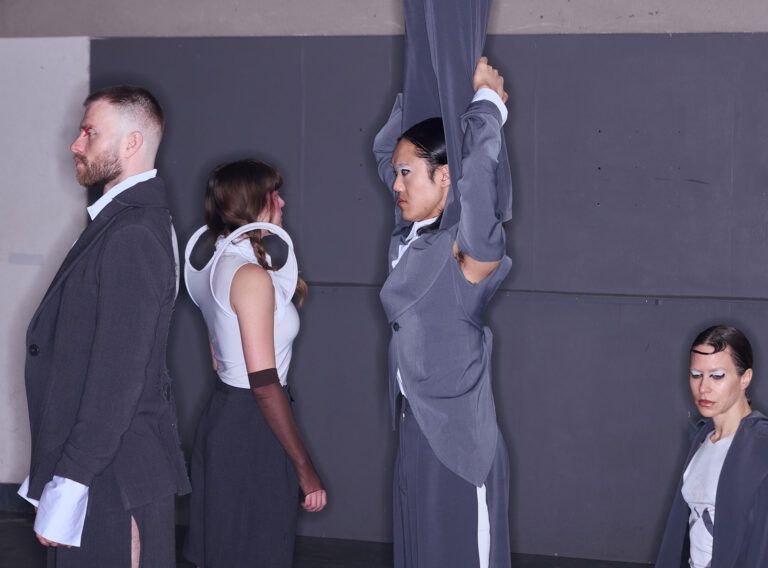
Each element of the newest collection of Eva Immerzeel, from material and shape to the texture of the loosely knitted overlays, was carefully and consciously selected to convey “the conflicting feelings one can have when struggling with making connections” and hopeful glints of hope in reaching out. More in the interview below.

How do you view the relationship between fashion and performance, with garments serving as channels for expression in live acts?

I believe fashion and performance go hand in hand. Fashion was made to be fluid, especially around a body where movement is constantly happening. The expression of a garment can add deeper meaning to a performance through the emotions of the designer, and in doing so, it deepens the emotional impact of the performance itself.

Currently, I am experimenting with using performance to further express my design choices, and it is a very different process. Designing with performance in mind really makes you think and ensures you don’t forget movement as an important factor.

Your colour palette leans toward shades of blue and silver, evoking the melancholy beauty of rainy days. What drew you to these hues, and is there a deeper meaning behind them in your portfolio?

In this collection, I thought a lot about colour and the feeling it would communicate. The collection is about the fear of committing, and with the colours, I wanted to show a contrast, symbolising the conflicting feelings one can feel when struggling with making connections. Where the blue tones stand for the sadder, deeper feelings, the yellow colours stand for a more positive view or hope that the connection is possible.

Once I had made the decision on which colour palette I would use, I had much more freedom in forming the individual pieces. Colours are such an important choice and carry a strong emotional message. Once you make the choice of what fits with your concept, it can give you more certainty about what your work is communicating.

While your colour palette is filled with meditative tones, your collections pulse with experimental energy. How do fabric experiments and unconventional techniques impact your design journey?

When I design, I am largely influenced by fabric experiments. For me, fabric is more than just a material – it’s a medium for exploration. I believe that there is a lot you can’t predict when working with different textiles, which leaves more room for discovery and creative expression. Each fabric has its unique properties, from how it moves and drapes to how it reacts to different techniques. This unpredictability is what makes the process so exciting. It allows me to experiment with texture, structure, and form in ways I might not have planned but that often lead to interesting results.

By embracing this experimental approach, I can let the fabric guide my design choices rather than having a rigid concept from the start. It’s this element of surprise that keeps me engaged and opens up new possibilities in my work.

How would you describe the essence of your newest collection, Ongebonden? What messages or concepts are you hoping to convey through these pieces?

“Ongebonden” explores the emotion behind living with the fear of attachments. This is expressed in a seven-part collection, where material, shape, and texture are used to convey a feeling. This work is a continuation of “Bindloos*”*. A mix of materials has been chosen, ranging from very delicate knits to stiff, heavy fabrics. The knits symbolise the fragile connections between two people, something that can easily be broken apart. The thick, stiff fabrics represent an imaginary wall that can be put up against others.

Additionally, natural latex is a recurring material in the collection. It is a complex but interesting product to work with. The symbolism behind the material adds depth to the collection; the temporary connections created by the latex once it has dried remind me of the deliberately brief connections someone with a fear of attachment might form with others.

Which project would you most like to feature from your portfolio, and what about this piece makes it especially important to you?

“Ongebonden” is currently my biggest project and also the one I am most proud of. I feel that it serves as a culmination of everything I’ve been working on in other projects over the past year. In previous works, I focused on individual aspects, such as perfecting my sewing skills, building a concept and making it personal while maintaining professionalism, and experimenting with materials. With “Ongebonden”, all of these elements came together in one cohesive project.

It was also the first time I shared my work with an audience, and I am truly grateful for how openly it was received. I learned a great deal from the experience and will always be proud of this collection. At the moment, I am working on a new collection, though it is still a work in progress. I look forward to sharing it with you later this year.

Did you like it?
Share it with your friends

Bio

Eva Immerzeel is a designer currently being educated in fashion design. In her work, she’s guided by curiosity and enjoys exploring new materials and forms, allowing each project to shape and evolve as she goes. For Eva, design is a process of exploration where every decision leads to new ideas and directions. She finds inspiration in the people and the world around her, drawing from everyday moments, interactions, and emotions. Through her art, she aims to express herself in a way that is both unique and familiar, presenting ideas that feel personal yet resonate with others.

Credits

Fashion Designer / Eva Immerzeel @eva_immerzeel

Interview / Kateřina Hynková @khynko

You may also like

Polish choreographer Iza Szostak’s circus is a philosophical system, a choreography of risk, precarity, and collective survival mirroring the contemporary condition. Discover today how her new performance Trapeze, premiering at Studio Hrdinů in Prague, turns the trapeze bar into a narrator, and the clown into an energy valve for a world on the brink of collapse.
“It is a story about a long night, about everything that disappears during the day and only comes out after dusk.” Polish fashion designer Pat Guzik breathes new life into her garments by collaborating with visual artists, such as Aleksandra Waliszewska and Zbiok Czajkowski, whose dreamy and tongue-in-cheek works adorn the skirts, sweatshirts, jackets, and other ready-to-wear pieces by the designer.
French painter and illustrator Sébastien Pastor navigates between naïve figuration and abstract expressionism, building visual worlds where bold color palettes pulse with rhythm and absurdity. Discover how his colorblindness became a creative signature and how he leaves room for the enigmatic in his works.
Spanish illustrator Laura Mestre transforms emotional overflow into tender visual poetry, using symbols of water, flowers, and cracks to map the quiet beauty hidden within difficult experiences. Discover how metamorphosis, instinct, and a fanzine called "Hay que volver" helped her reclaim drawing as both refuge and release.