THE STUBBORN PRESENCE OF THINGS

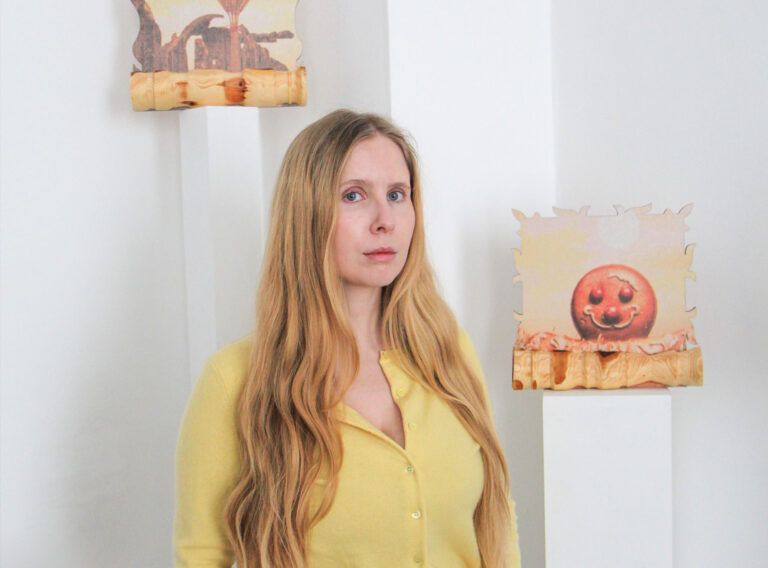
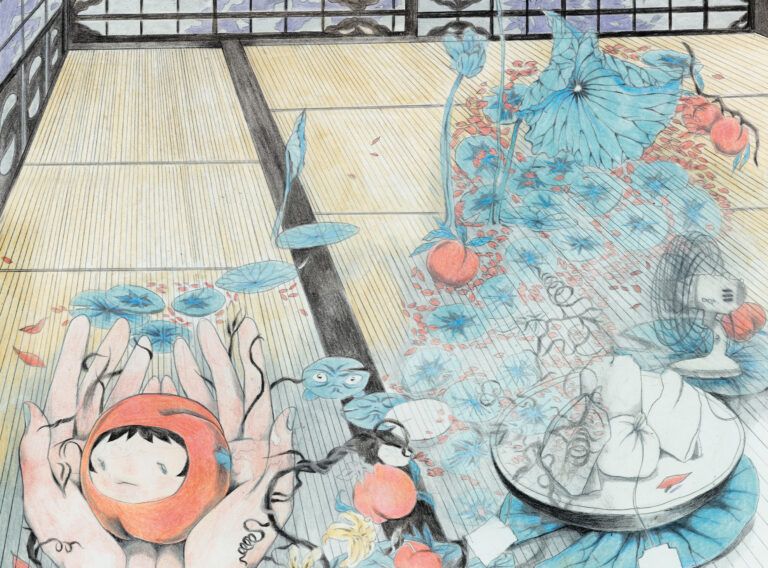
Visual artist Ekaterina Skvortsova-Kowalski celebrates the overlooked yet aggressively present: stray cats, neon-clad janitors, dust-covered plants... transforming everyday resilience into joyful resistance. Discover how three cities, spontaneity, and a refusal to darken the world shape her vibrant practice in today's interview.

Your work often balances between precision and play, clean forms and whimsical characters. How do you navigate the line between control and spontaneity in your creative process?

My process is pretty down to earth. Once I decide an idea is worth pursuing, I block out a loose composition on my iPad, dropping flat blobs of color where key elements go. Since I tend to forget what each blob represents, spontaneity slips in naturally. When the composition feels right, I transfer it to a surface and let the material do its thing.

You live and create between Baku, Moscow, and Istanbul – three cities with distinct rhythms and visual textures. How do these places seep into your palette, patterns, or sense of storytelling?

As much as I love to categorize information – I keep both Notion, Obsidian, and a paper notebook – I’m no good at dissecting my own art. Also, I try to approach every person or thing I meet without prejudice and listen for its unique tune, avoiding generalizations as much as possible. One thing I can say, though, is that while in Istanbul my muses were cats, in Baku I take a lot of inspiration from janitors. It’s ironic how service workers are supposed to be invisible, yet in Baku they wear bright neon uniforms with reflective stripes and drag bright red dust bins.

As for Moscow – I spent 30 years there and used to think that, being a cosmopolitan city, it was incapable of influencing me much. At a distance, I’ve come to realize the influence was enormous. My graphic novel is partly about that.

There’s a joy and boldness in your compositions, but also a quiet introspection beneath the color. Do you see your art as a kind of emotional translation of shifting inner states?

Yes, absolutely. There’s the technical side to art – anatomy, composition, medium – but it’s this heartache of seeing, experiencing, and being that drives us to create in the first place.

You often use mixed media, from colored pencils to digital collage. Does switching materials feel like shifting languages, or do you treat them as one extended visual dialect?

No, definitely not shifting languages. If you want a vocal metaphor, I’d say they’re musical instruments. You can play the same tune using any instrument, but In the Hall of the Mountain King just doesn’t work on piano.

You move fluidly between brand design and visual art, commercial and personal worlds. What are your favorite themes or characters that appear in your art?

I’ve thought about stopping signing my paintings, because if a sassy cat is looking at you from the picture, the authorship is pretty obvious. Apart from animals, people in uniforms are a huge inspiration – especially janitors and policemen. The fact that in some places painting the latter is illegal only makes them more intriguing, so I look for ways to sneak their presence in subtly.

Brand design is another story. It has to speak in a voice that’s not mine by default, so bringing in any characters just because I like them would automatically mean a bad job.

Your recent exhibitions, Exuberant Enjoyment of Life and Happy Coincidences, suggest a fascination with chance and celebration. How does coincidence function in your artistic universe?

I used to be quite obsessive about planning, only to watch most of my plans go down the drain. Then I realized that the best moments in life are coincidences, so I gave up on trying to steer the natural flow of things. What I still manage, though, is my own effort – planning it keeps me fit, productive, and ready for whatever surprises come my way.

Cats, plants, and floating shapes appear across your imagery. What draws you to these recurring symbols? Are they personal talismans, or simply playful forms of escape?

My art is certainly not about escaping – it’s about being present. Stray cats are overwhelmingly present, even in places where people wouldn’t be. The same goes for seagulls and pigeons: they’re aggressively present no matter how much they’re shushed away.

The stubborn presence of plants in cities is both sad and reassuring – they’re covered in dust, crippled, and short of breath, yet it’s them who shall inherit the earth.

Your works seem to celebrate lightness and humor, even in uncertain times. Is joy a form of resistance for you?

One hundred percent. I used to enjoy dark, “honest” art – the kind that stares straight into the wound. I poked at that wound long enough to confirm that yes, life is tough, unfair, and for many people unlikely to get better. But adding more black paint to that abyss always felt wrong.

In the face of cruelty and unfairness, one still has to keep looking for a purpose to live. I decided mine was to lighten things up, even if it risks my work being dismissed as “unserious.”

You’re working on a graphic novel, a more narrative, long-form medium. How do you imagine this project expanding or reshaping your artistic voice?

Each project shifts your voice a little, but I don’t expect a major transformation. I’ve published short stories – both graphic and textual – and translated novels, so long-form storytelling isn’t new to me. This one is special not because of its size, but because of its depth. I like my protagonist, and I expect her story to grow into several books.

Did you like it?
Share it with your friends

Bio

Ekaterina Skvortsova-Kowalski is a visual artist and brand designer working across Baku, Moscow, and Istanbul. Her practice encompasses acrylics, colored pencils, collage, and digital techniques, transforming everyday observations into vibrant compositions that celebrate the overlooked and aggressively present.

Her work has been exhibited in solo shows at GaleriBu Istanbul and MerqezArt Gallery Bodrum, and has been recognized by the World Illustration Awards, Communication Arts Design and Illustration Annuals, and Jackson’s Art Prize. She won the HSE Creative Open in 2023 and the Treviso Comic Book Festival’s Nuovi Autori prize in 2021.

Credits

Illustration /Ekaterina Skvortsova-Kowalski @e_kowalski

Interview / Markéta Kosinová

You may also like

Spanish illustrator Laura Mestre transforms emotional overflow into tender visual poetry, using symbols of water, flowers, and cracks to map the quiet beauty hidden within difficult experiences. Discover how metamorphosis, instinct, and a fanzine called "Hay que volver" helped her reclaim drawing as both refuge and release.
In my last year’s review, I wrote that some part of me wished to keep PAF jealously to myself. Either that wish has not been intercepted in the ether or has been twisted completely because the 2025 edition of PAF, Festival of Film Animation and Contemporary Art in Olomouc, Czechia, was bursting at the seams; again. However, it’s one of the Czech festivals that deserves to be sold out and a bit cramped, and I’ll tell you why.
Czech painter Lukáš Šmejkal traces the unstable boundary between body and terrain, composing lyrical visual assemblages where electric pylons become threads and human figures dissolve into the landscapes they inhabit. Discover how photography, movement, and Baroque verticality shape his meditations on perception in today's interview.
Between November 14 and 16, 2025, the international and multidisciplinary FASHIONCLASH Festival once again descended upon Maastricht, the Netherlands. SWARM MAG’s co-founder, Kateřina, was kindly invited to be a member of the jury awarding the best fashion film at the festival’s 17th edition. We also dispatched the other co-founder, Markéta, on a little delegation to accompany her and glean the strongest currents and tendencies in contemporary young fashion design and performance art. Together, they now present their highlights from the three-day event.