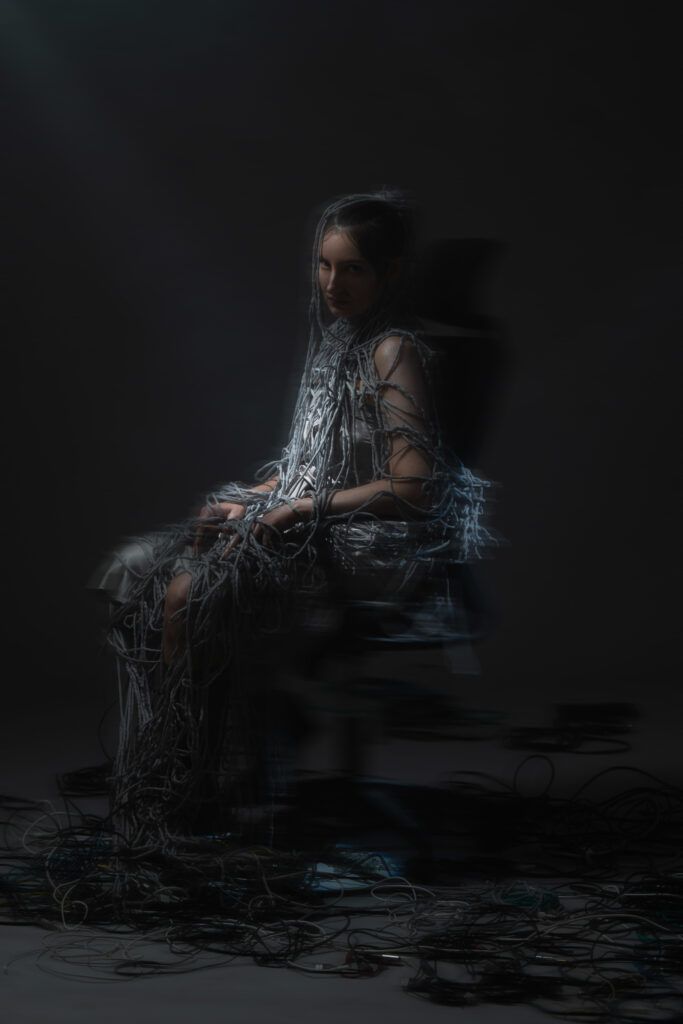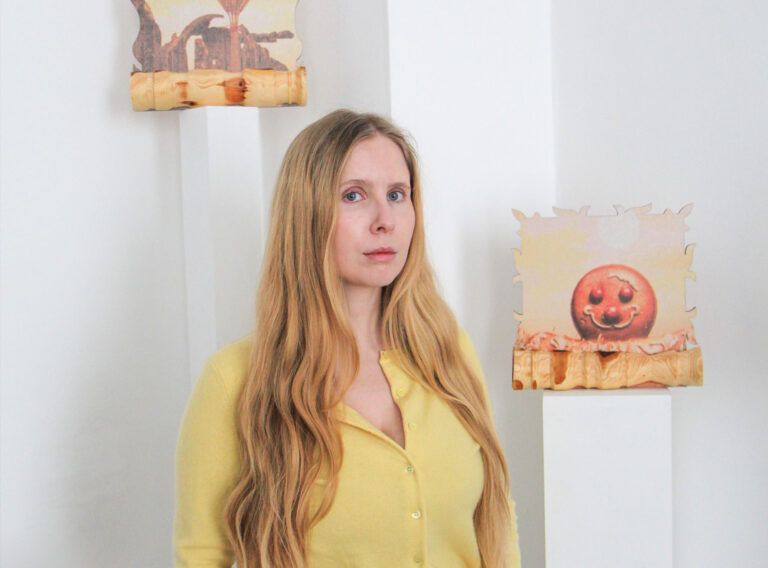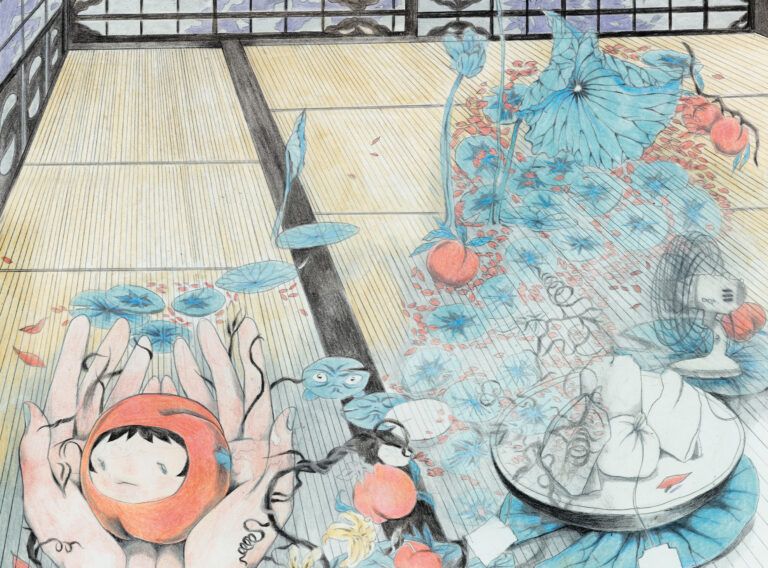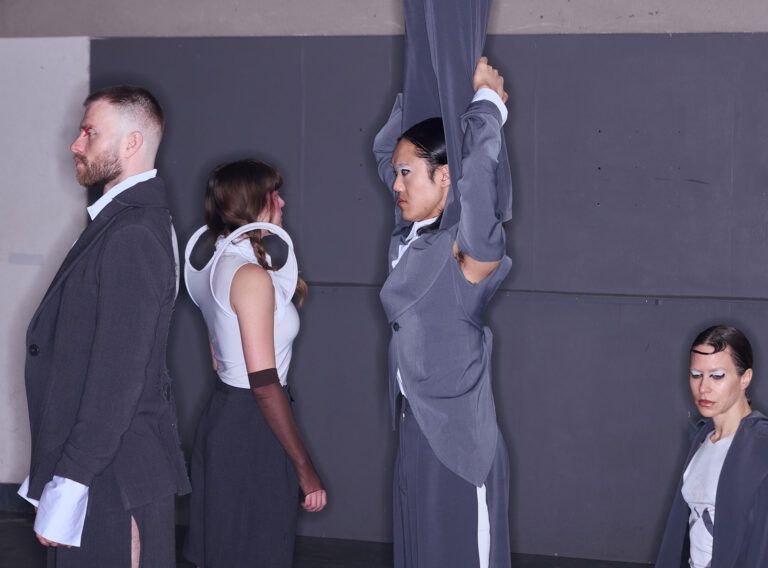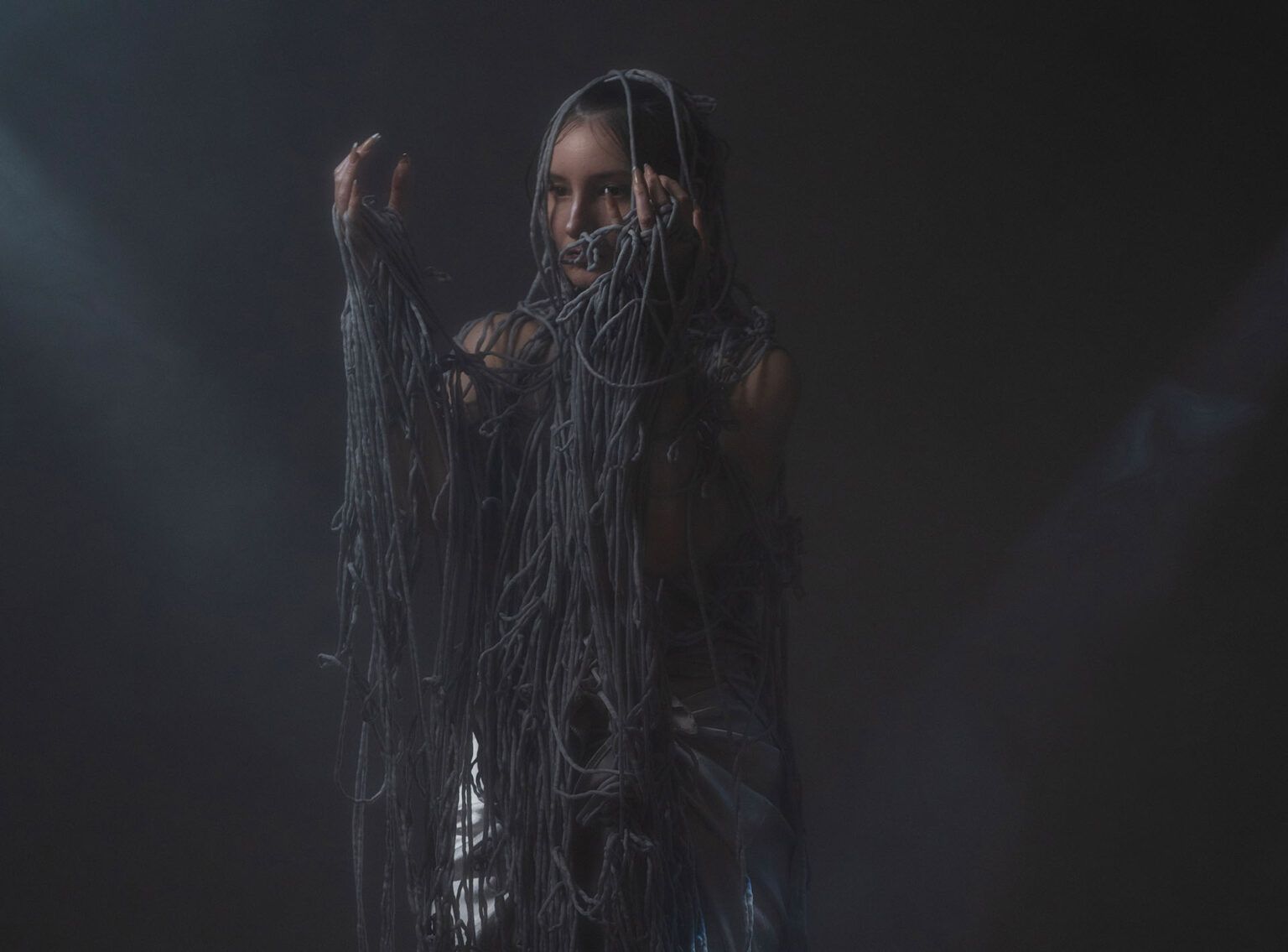
“I crave the complicated because it entertains my brain.” At the 2026 Lunchmeat Festival, nan Cifra (the newest nom de plume of composer and musician Natálie Pleváková) will present her performance Tangled in Narratives, playing material from her debut album. Together with performer and choreographer Jitka Sara Pánikova, visual artist Jan Matýsek, and a custom-built instrument Harpo, co-created with Magdalena Rybanská, and Antonín Gazda, they will introduce a performative world “where sound, physicality, and visuals become abstracted elements of narrative perception.” Natálie kindly let us peek into her creative processes in an exclusive interview.
An aside for those who want to discover more intimate audiovisual events in the Czech context: Natálie also founded Sanatorium Sonorum, a one-day festival (usually) taking place at Cabin Studio Pěčice, a former hunter’s lodge that holds historical significance as the past residence of Czech composer Bedřich Smetana. Selected artists and musicians take several-week-long residencies there before showcasing the fruits of their hermit sojourns at the festival.
The live AV performance was commissioned by Lunchmeat Festival. See nan Cifra there on Friday, September 25th, 2026, at the Trade Fair Palace in Prague.
Natálie, let’s start from the very beginning: how did you arrive at the name, nan Cifra, and what does it represent?
For the past few years, I’ve been really interested in human consciousness. I’ve been reading about its evolution and the so-called hard problem of consciousness. Partly because of all the AI havoc.
I’m a fan of technology, but I think we still have a long way to go in our development as human beings. And I think it’s a bummer that technology draws our attention away from our own different forms of intelligence and disconnects us from ourselves. We then imprint our limits on the technology we create. And if one day AI agents solve some great mysteries of life, we might not be able to understand their answers anyway. The limits run both ways, but ultimately we’re still trying to understand everything through our own consciousness.
We bring ourselves into how we read the world: our interpretations, our focus, our conscious and unconscious choices, even our feelings about things and people. Of course, there are things we can more or less agree are objective. We might agree on what to call green, for example, without knowing whether we experience it in exactly the same way. I wanted that tension between shared meaning and private experience in the name because, to me, it gets at the essence of things.
As you can see, I’m not fond of quick and easy. I crave the complicated because it entertains my brain.
I also like the rhythm of the name and its ambiguity. In Czech, cifra can mean a digit (btw, super fun how our brains struggle to grasp the actual scale of quantities) or an ornament. Its roots reach back to the Arabic word for zero or emptiness, and it shares those roots with “cypher”. I like that journey from emptiness to meaning and back. That’s why there’s also the nan: it comes from computing, and basically it’s a value returned when the system ‘can’t make sense of something’ – which is something I thrive on because that’s the moment we start learning.
How would you characterise your sound? What do you use to create it?
I like how Jan Matýsek, who does the scenography, and Jitka Pániková, the dancer and performer in the show, described it when they first heard it: as if they’d stepped through Alice’s looking glass. I’d take it a little further and say I’d like to hand you a hearing trumpet, like the one in Leonora Carrington’s novel. Physics meets psyche. Magical realism.
As for making it, I’m very technology-driven. I mostly build my sounds from scratch through synthesis, nerding out until I find something that intrigues me. At the same time, I’m very reactive and intuitive. I might make a whole track around the “ping” of a text message if it catches me in the right mood. The ways you can bend a sound… don’t even get me started!
Your Lunchmeat premiere involves quite a few elements: a performance, visuals, and a custom-built instrument: Harpo. How did it all gradually come together?
At some point, the process revealed how everything was entangled. At first, I didn’t know exactly how all the elements I wanted in our little show world connected. Once we started building the environment, it clicked. It’s about discovering relationships and staying open to new ways of linking body and mind.
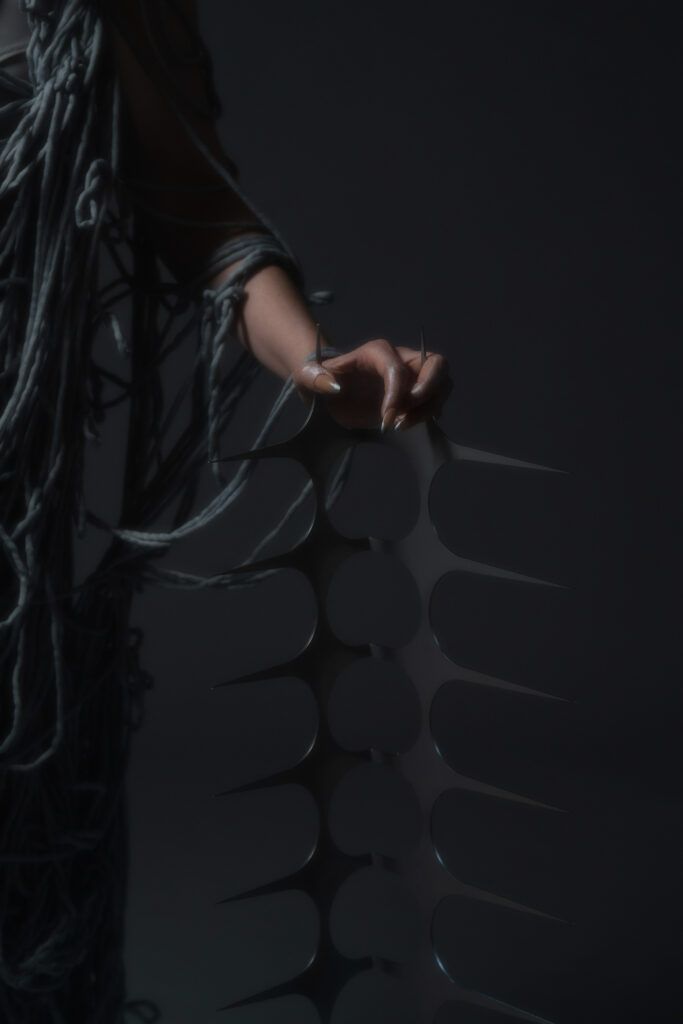
Harpo, whose visual form was realised by Magda Rybanská, is an instrument I’d had in mind for quite some time. I’ve been developing it on and off for two years. It revisits something familiar, a harp, and asks you to rethink what it can be. I use it as a MIDI controller, so it doesn’t have to sound like a harp. With Antonín Gazda’s help, it can also function as an electric harp, though that would be a more conventional use of it.
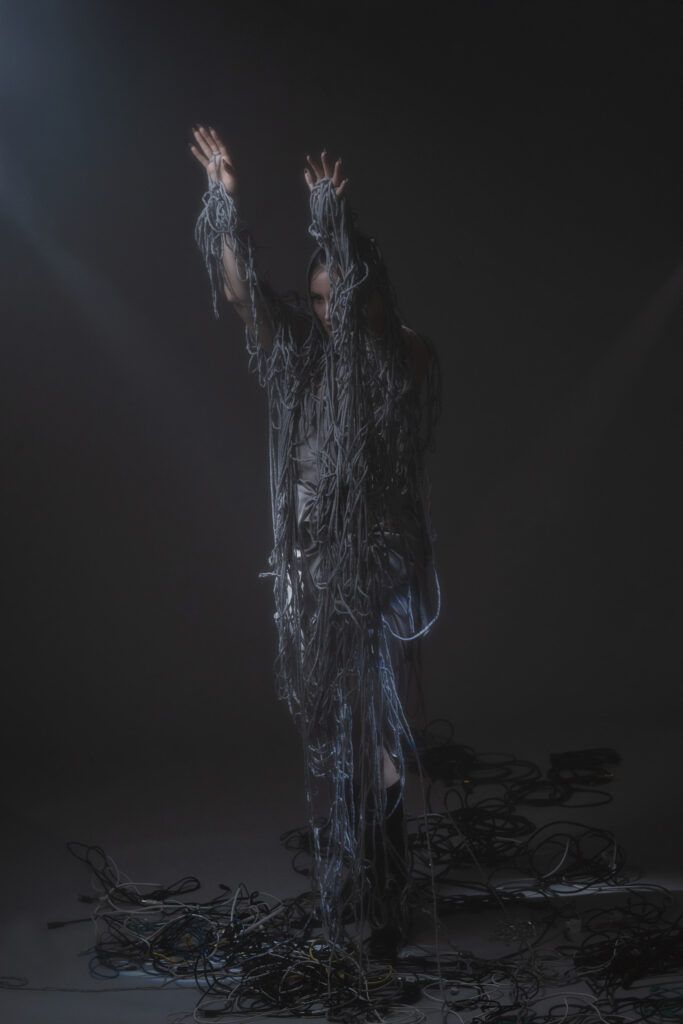
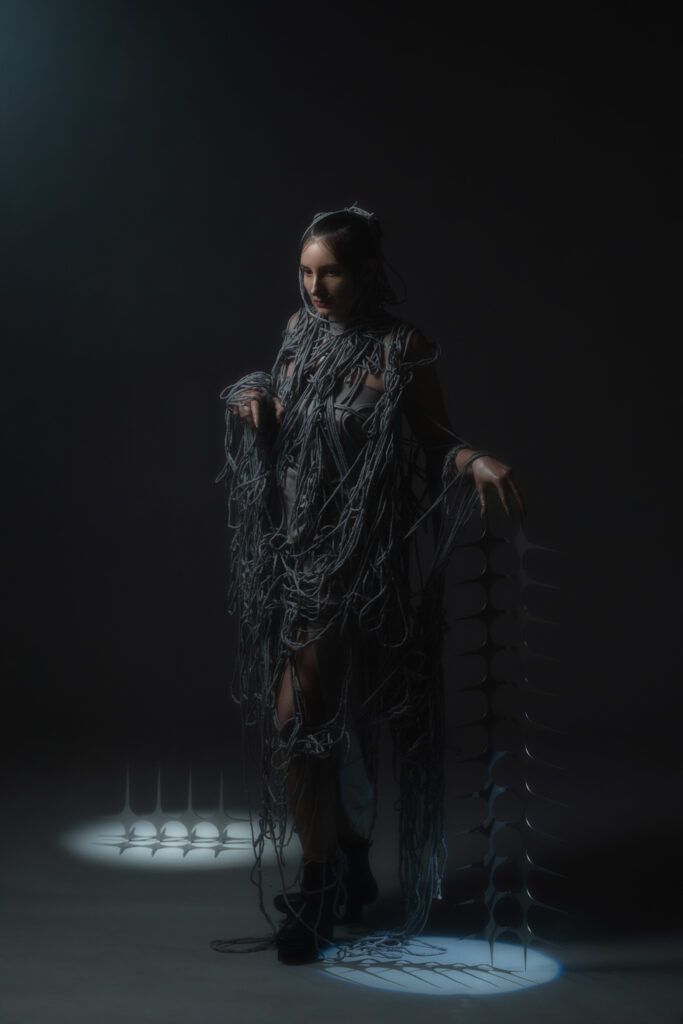
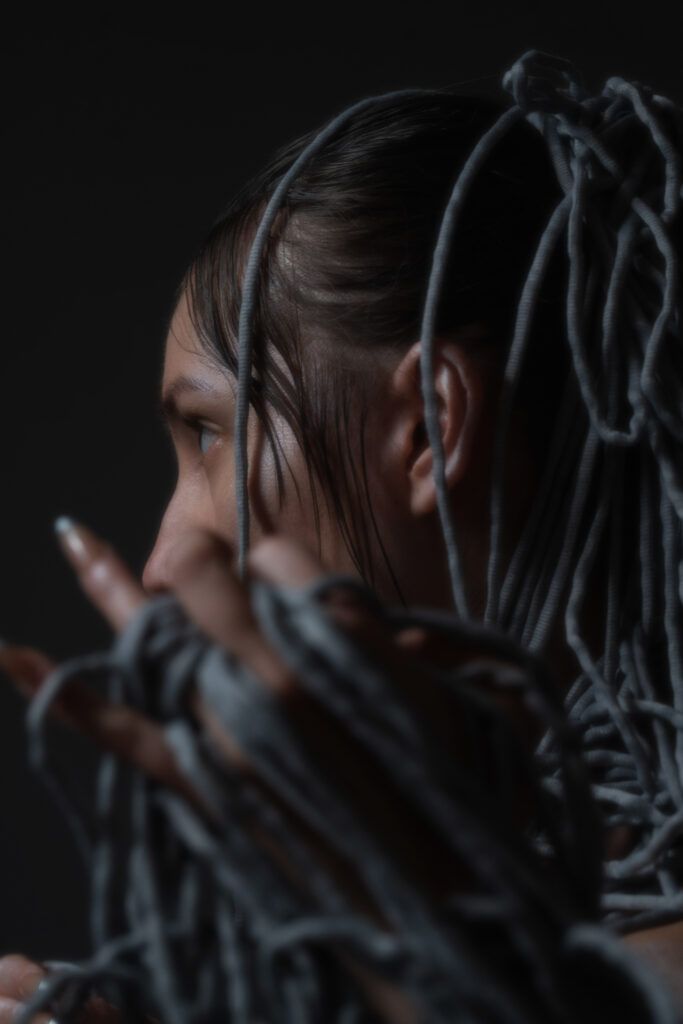
The videos are closely connected to the dancer and me; they’re the “looking glass” of the performance. There are perhaps two narrative threads embodied by the two performers: a bio/soul-hacking singing entity, me, and a hardware/software gynoid, a female humanoid figure portraying the bodily aspect of existence. I don’t see them as a duality, but as parallel expressions of a being.
What was the initial idea for Tangled in Narratives? What sparked its creation?
I’ve always been fascinated by how language shapes our understanding of the world and our place in it. It’s a powerful tool of reason, and we live in a world that treats rational knowledge as the ultimate source of understanding. The most boring tale since the Enlightenment, btw.
In a way, we’re all living our own friction of a fiction, or, if you like, our own portion of reality. This connects to what I’ve been reading about consciousness: qualia, the felt qualities of experience, and the hard problem of why physical processes are accompanied by subjective experience at all.
Our sense of reality develops through the stories of our lives. Sometimes we forget where those stories came from or identify with them too much. I’ve done that myself. So, in this project, I’m allowing myself to revisit why I feel the way I do and why I think the way I do. I think it would do us all good to revisit our own narratives every now and then. Familiar loops and patterns can be hard to leave. We’ve been taught so many things that are untrue or no longer hold, yet we still base our worldviews, our self-image and our readings of other people on them.
You have experience playing smaller-scale venues and festivals (and you founded one yourself): do you expect performing at Lunchmeat Festival to be different?
Well, I’m curious to find out. I don’t think the size of the crowd matters that much when you’re doing something you feel the need to do. So far, I’ve really appreciated all the care and support the Lunchmeat people have given me.
What do you wish to convey to the Lunchmeat audience? What do you want them to perceive in your performance?
Feel your facts, pls be weird, try out telepathy exercise and send light people’s way always (these are also some of the names of the tracks I’ll be performing). But really, if there’s any sort of connection, I’m happy. That’s why we’re here, babez.