RESTLESS MODERATION

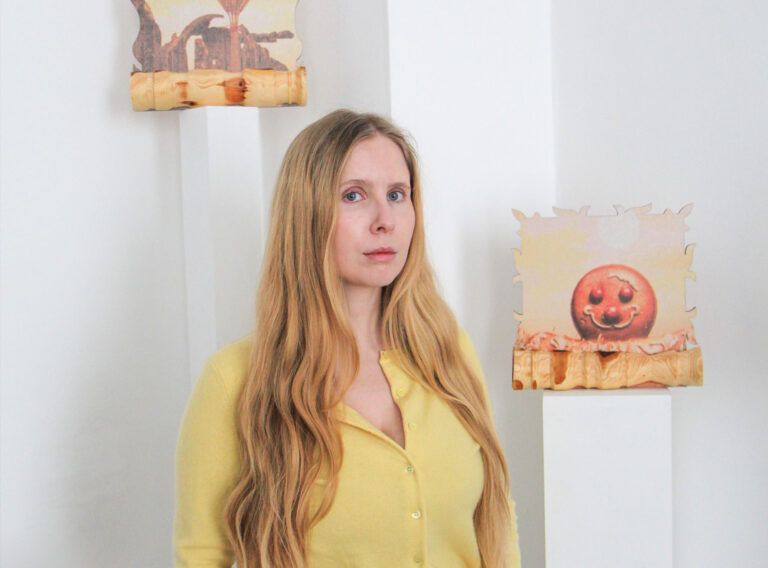
Dominik Málek’s explorations of selfhood, binary opposites, and fantasy have led him all the way to the Světova 1 gallery, where he has recently presented his installation Jacuzzi of Despair. For today’s feature, we sat down with Dominik to learn more about his work, creative approach and inspirations to gain deeper insight into the mind of the upcoming Czech artist.

Tell us about your recent installation. What is its concept and what form did you use to express it?

In the group exhibition Jacuzzi of Despair at Světova 1 gallery I worked with the theme of roots – connections – umbilical cords. I exhibited oil paintings on the wall along with objects pointing in different directions, sometimes hanging down from them, sometimes reaching the floor.

The main idea of this installation was becoming, finding our own identity, entering the next phase of our lives. The objects come out of the images, from the two-dimensional they manifest into the third dimension, the idea finds a new form, a new medium, a new dimension and lives its own life. But there is still a kind of umbilical cord, roots, threads that point to where the objects come from. They point to their previous 2D phase, which, when seen, might be more understandable why the object is the way it is now. It’s about connecting the past, present and future in terms of internal and external development.

I hoped that one day the objects would be able to stand alone and lose the connection between them and their origins. Sometimes it succeeded and made sense, sometimes it didn’t work without the connection so well.

You mention the finding of identity and personal development. How is it present in your works, and has your view of these concepts developed over time?

A similar theme was explored in my most recent thesis, which deals with the interconnectedness of our/others’ physical bodies and the experiences we receive through those bodies. I have been thinking about how past experiences, memories, experiences, traumas, etc. manifest themselves into our present bodily shells. Between the paintings I installed the body of an indeterminate being consisting of ceramic objects that were interconnected with woolen cords symbolizing the interconnectedness of everything. The body walked through the building and the institution of the school it was in, limbs penetrating the wall, sometimes randomly peeking out of the wall, sometimes crawling on the floor.

What is the connective tissue between your artworks? Do they all share a common inspiration?

In all my paintings I look for a kind of balance between moderation, aesthetics, attractiveness and planning, and on the contrary there is also restlessness, relaxation, permission to do anything, dirt, wildness, childishness. I look for a balance between good rooted in evil and evil rooted in good. I enjoy fairy tales and mythology, which are a window into my childhood memories. Most of all, I enjoy stories where the negative character shows his humanity and we discover the hero may not have been as good as he seemed. Because that’s how I think it works outside of the fairy tale world, nothing is black and white.

I interpret my memories, my experience of the present, and my desires and fears about the future through various symbols, animate and inanimate objects, characters human, animal, and something in between. Some symbols don’t have a clear interpretation, sometimes they are just there and radiate something of themselves.

Did you like it?
Share it with your friends

Bio

Dominik Málek (*1996) is a visual artist whose current primary focus is painting, but he also explores connections with various other media. His work is rooted in installations and the creation of objects using ceramics and other materials. In his pieces, he delves into the psychology of characters, the mental state of both living and inanimate objects, and other beings that inhabit the artist’s inner worlds, experiencing various states and relationships within them. An important element of his works is the quest for harmony between opposites in various formal and thematic dimensions. The artist is currently studying in the Painting 2 studio at the Academy of Fine Arts in Prague.

Credits

Artist / Dominik Málek

https://www.instagram.com/dominikmalek_/

https://malekdominik.tumblr.com/

Translation / Tomáš Kovařík

Off_Spolecne a potají_21 – Výstava Společně a potají, Gallery Off/Format, foto: Jana Ovčáčková
Světova 1 – Exhibition Jacuzzi of Despair, Gallery Světova 1, foto: Karolína Matušková © SVĚTOVA 1 AS
Summer crits AVU – foto: Chelsea Cheng

You may also like

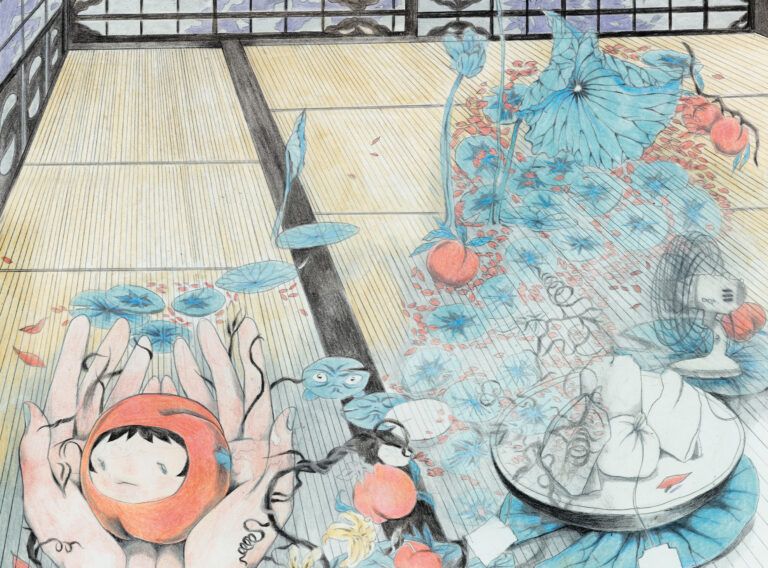
Ema Prosová's work doesn't announce itself loudly. Her drawings and paintings on silk operate in a register that's contemplative, layered, almost whispered: figures emerging from lychee fruits, hospital rooms floating in eerie space, architectural fragments mingling with natural forms. The work comes from years spent moving between cultures and techniques, learning lacquer painting in Vietnam, silk painting in Indonesia, living in Tokyo, and now finishing her degree at the Academy of Fine Arts in Prague.
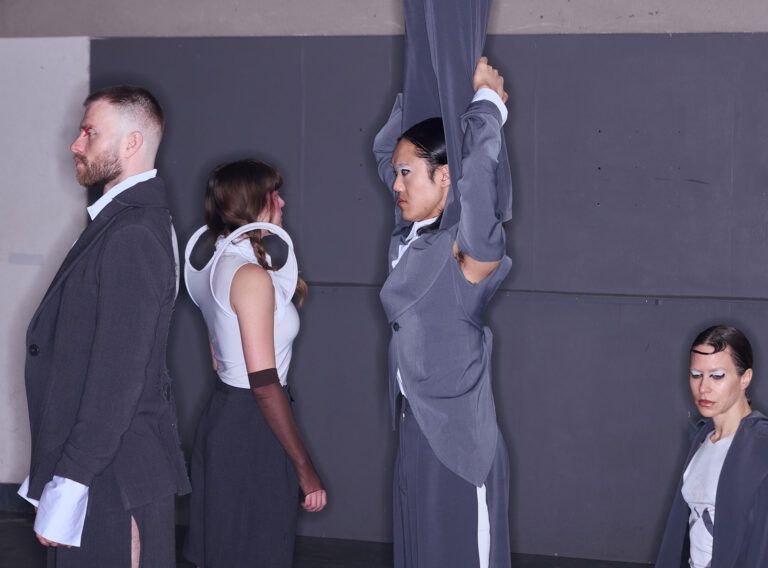
Polish choreographer Iza Szostak’s circus is a philosophical system, a choreography of risk, precarity, and collective survival mirroring the contemporary condition. Discover today how her new performance Trapeze, premiering at Studio Hrdinů in Prague, turns the trapeze bar into a narrator, and the clown into an energy valve for a world on the brink of collapse.
“It is a story about a long night, about everything that disappears during the day and only comes out after dusk.” Polish fashion designer Pat Guzik breathes new life into her garments by collaborating with visual artists, such as Aleksandra Waliszewska and Zbiok Czajkowski, whose dreamy and tongue-in-cheek works adorn the skirts, sweatshirts, jackets, and other ready-to-wear pieces by the designer.
French painter and illustrator Sébastien Pastor navigates between naïve figuration and abstract expressionism, building visual worlds where bold color palettes pulse with rhythm and absurdity. Discover how his colorblindness became a creative signature and how he leaves room for the enigmatic in his works.