IMAGING THE EFFIGY

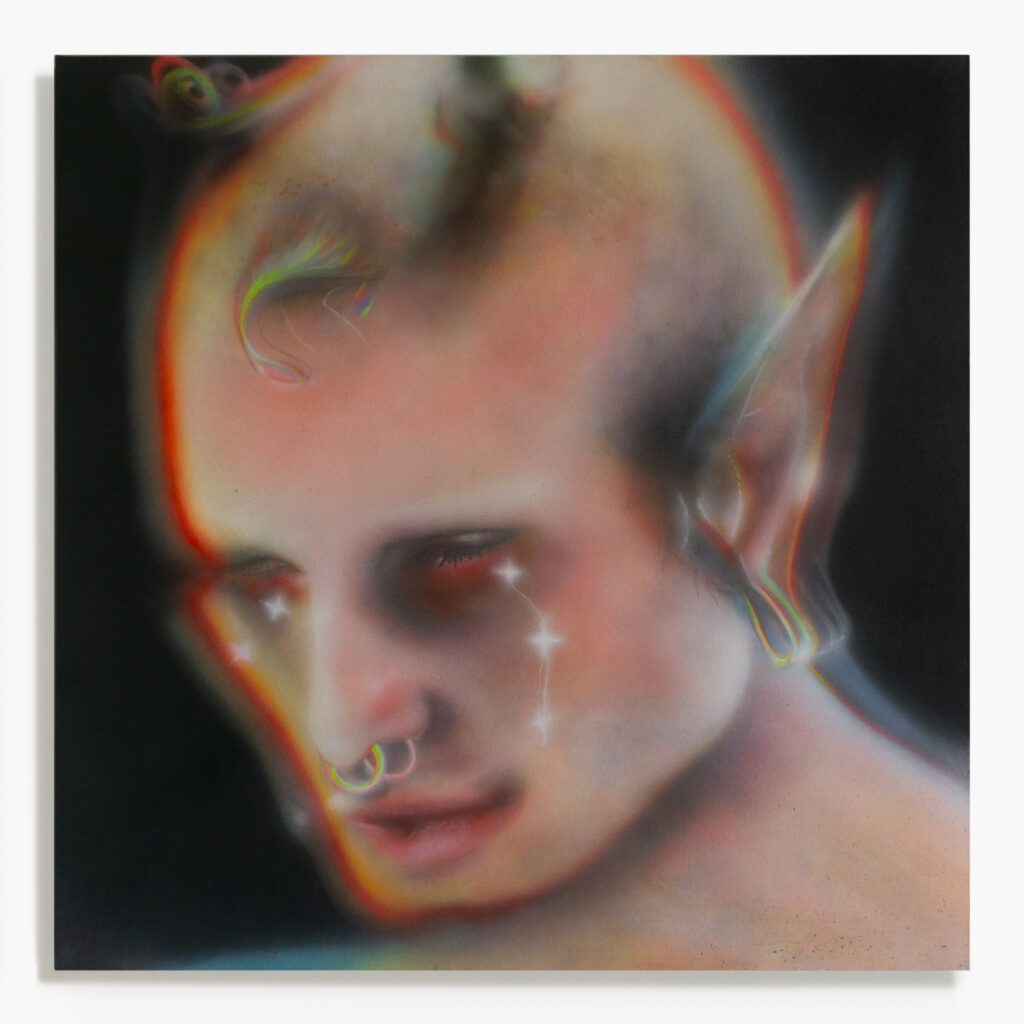
“I pull the symbolic scalp of their face. Then after modifications, I put it on”. Zbiok Czajkowski captures the shells and masks of people who were by chance caught in old photographs, and in his recent series “Scalps” he perfects his method with his mastery of airbrush. Read today’s interview to find out what lies beneath the surface.

Can you tell us about your latest painting series and its title, “Scalps”?

I have named my latest painting series “Scalps.” I paint them with an airbrush, a technique derived from my long practice as a painter rooted in graffiti. The subjects of my paintings are human images. One might get the impression that I paint portraits, but this is not entirely true. What interests me in them are the shells, the effigy. I process them and create masks from it. Or to put it literally, I pull off their scalps, which I then dress up myself.

Your paintings are photorealistic, but you’ve mentioned they aren’t about celebrating the faces you depict. Can you elaborate on that?

My latest paintings, although they are maintained in a photorealistic manner, are not a praise for the proud owners of the faces I have found. The portraits I paint are masks behind which I, the artist, hide. I literally cannibalize the found images. In order to express my own emotions, needs, desires, and beliefs, I need a mask behind which I can hide, free of conventions and social norms.

What draws you to create these masks, and how does that relate to your sense of self-expression?

I am not interested in beauty. I am interested in being weird, in the improper, in expressing myself. Being a weirdo is an emanation of my own personality. By putting on the mask, I gain the courage to talk about my emotions without restraint.

Who or what are some of the key inspirations for your work?

The most important inspiration for my work is the attitudes and expressions of the people who made up the subcultures of the early 1980s. I am fascinated by the courage and anti-establishment of the punks, goths, new romantics, the Blitz Kids, Leigh Bowery, and the New York Club Kids of the time.

How do you create these masks, and what role do found photographs play in your process?

My latest paintings are created by processing found photographs. On their basis, I prepare my effigy masks. I do it because it gives me the possibility to control the way other people perceive us. Other people will see the mask; what is underneath will remain hidden. By putting on a mask, we can paradoxically be our truest selves.

You’ve described the images you use as “materials.” What does that mean, and how do you choose them?

The found images that I use in my paintings – I refer to them as materials. Those samples should first and foremost belong to the background collection. What does this mean? For me, belonging to the background set means coincidence. Faces found in this way are not posed. Those images are not studied; they have been caught by chance without any intention of being in the foreground, literally and figuratively.

How do AI-generated images fit into your works?

In my artistic practice, I look for secondary and tertiary faces, people from the background, from the distant plane. For the same reason, I like to use AI-generated images. I am fascinated by the imperfection of computer-generated faces. I look for mistakes and strange modifications in them.

How do you integrate these images into your work?

The images I am looking for have to be symbolically sanitized, sterilized of extraneous emotions, in order to serve as material for a mask that I could wear in public. I pull the symbolic scalp of their face. Then after modifications, I put it on. It gives me the courage to talk about myself. This is how I explain to myself the world around me.

Did you like it?
Share it with your friends

Bio

Polish-born painter, illustrator, and graffiti artist. The artist’s main mediums are painting and street-inspired illustration. In his artistic practice, he uses an airbrush to create hyper-realistic paintings, which he describes as realistic surrealism. Zbiok paints non-portraits, which he refers to as Scalps. These are found, processed visual samples from which he creates mask-paintings, which he then metaphorically dresses up. The masks allow the artist to speak directly about his fantasies, needs, and emotions. They enable him to express his own self in an uninhibited way, without reference to his physicality.

A key focus in Czajkowski’s work is aesthetics. He deliberately uses the airbrush in his paintings, a technique derived from his many years of experience painting graffiti. The airbrush allows him to achieve a visual language that emulates images viewed on phone or computer screens. The artist incorporates the ubiquitous flood of visuals and AI technology, searching for errors and distortions. Zbiok’s intentional emphasis on digital imperfections – blurry, fuzzy images, distortions, glitches, and random mistakes – creates a distinctive language of expression that reflects the visual fetishism of the Screen Generation.

The artist’s work is deeply inspired by the attitudes and expressions of people from the subcultures of the early 1980s. He is fascinated by the courage and expression of punks, goths, and new romantics. The Blitz Kids, Leigh Bowery, the No Wave movement, and the New York Club Kids of the time are among his greatest inspirations.

Credits

Artist/ Zbiok Czajkowski @zbiok

You may also like

“I crave the complicated because it entertains my brain.” At the 2026 Lunchmeat Festival, nan Cifra (the newest nom de plume of composer and musician Natálie Pleváková) will present her performance Tangled in Narratives, playing material from her debut album.
French and Belgian artist Léa Porré excavates relics of our collective memory, translating her digital worlds into forged steel, jacquard tapestries, and stained glass. In today's interview, discover how the self-described dream archaeologist stepped away from the screen to stage impossible encounters with the past.
Ema Prosová's work doesn't announce itself loudly. Her drawings and paintings on silk operate in a register that's contemplative, layered, almost whispered: figures emerging from lychee fruits, hospital rooms floating in eerie space, architectural fragments mingling with natural forms. The work comes from years spent moving between cultures and techniques, learning lacquer painting in Vietnam, silk painting in Indonesia, living in Tokyo, and now finishing her degree at the Academy of Fine Arts in Prague.
Polish choreographer Iza Szostak’s circus is a philosophical system, a choreography of risk, precarity, and collective survival mirroring the contemporary condition. Discover today how her new performance Trapeze, premiering at Studio Hrdinů in Prague, turns the trapeze bar into a narrator, and the clown into an energy valve for a world on the brink of collapse.