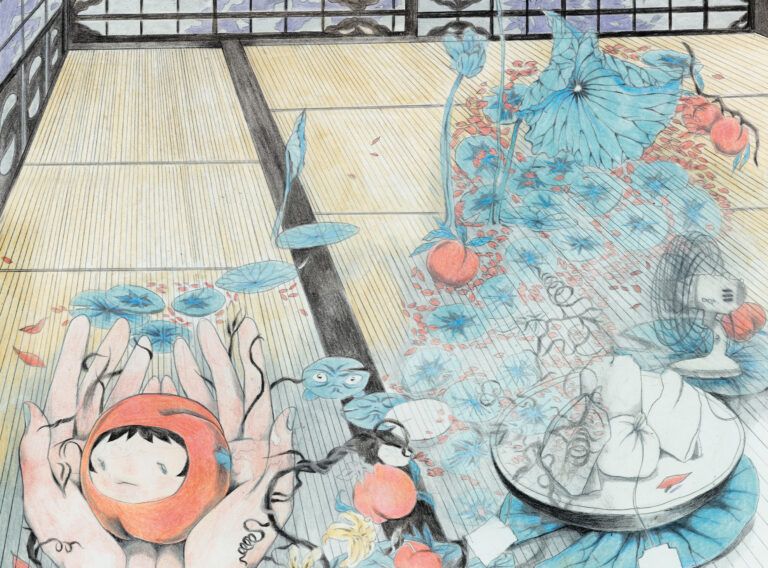
Dryaarisi / Dryaarisi is a short video poem exploring the motifs of detachment, memory, and the transformative power of myth. The video portrays the story of a pilgriming dryad on a journey towards discovering unknown territories, moving through a landscape resembling a form of a polymorphic shelter. Guided by an ethereal voice, the dryad enters a dream realm where they unfold reminiscences of reality, depicted in a surreal scenery, expanding with the pace at which the dryad uncovers it.
The video poem depicts the dryad’s journey as a metaphor for change, where detachment can lead to new discoveries. The dream landscape is a place of nostalgia, where the dryad recalls memories of reality that feel so close yet still somehow distant. Merging surreal depictions with a poetic voiceover creates a realm that establishes its own time and space.
Dryaarisi invites its viewers to embark on a journey of self-discovery, where detachment can lead to new perceptions and transformative experiences, reflecting on the power of nostalgia while discovering a new place.
How does the dream landscape serve as a place of nostalgia, and what role do memories play in the overall narrative?
Throughout her journey, the dryad enters three different landscapes – she starts at the most seemingly fantastic one, the one that often occurs in old adventurous expedition films. The voice encourages her to explore as soon as she finds herself within the realm. Towards the end of the first landscape sequence, we can see her examining a necklace with an eye – an indication of knowledge, experience or sentiment she is yet to discover. In the second landscape, we can observe the dryad getting more and more familiar with the realm. She interacts with it, stroking the leaves and letting them surround her body. She seemed more at ease as if this environment reminded her of something she had seen before.
Meanwhile, the voice still lures her into experiencing more and more of the landscape, and as she enters the third, last part of the realm, her demeanour now becomes not just relaxed, but ecstatic. Finding herself amidst the seashore, she finally feels fully adapted to the new environment, blending with it. But then, at the very end of the film, she discovers the corpse of a dead crab; something that reminds her of the inevitable part of reality; a memory of change and mortality.
How does the polymorphic shelter in the landscape contribute to the overall symbolism and narrative of the dryad’s journey?
The landscape itself is ever-changing, semi-realistic, semi-surreal. Its warmth and magic seem inviting, while the voiceover guiding the dryad tells her about how the realm itself is ready to embrace her. Such an assurance is comforting to the dryad; and the more she can get used to all the stimuli around her, the more the landscape seems to function as a form of shelter. When she discovers the necklace with an eye, the voice tells her “Wait for a while, and the world might open itself to you,” implying that she should take her time to settle in first and feel as one with the realm before confronting herself with what will be the reminiscence of reality.
Zagovory / In Eastern Slavic mythology, zagovory is a form of verbal folk magic. Users of zagovory can enchant objects or people.
This short visual poem, bearing the name of the Zagovory phenomenon, works with the aesthetics of Slavic folklore, body, and natural sceneries. Within long meditative sequences consisting of bodies moving through organic landscapes, it transforms the mysterious power of enchantment and healing into comprehensive visuals, supplemented by a voiceover, reading some of the authentic zagovory in the Russian language.
The central artistic focus of the work oscillates around the process of purification, healing, and ritual, using the elements of Slavic folklore, and the connection of body and nature. Depicting two different characters and their intertwined micro-narratives, Zagovory transforms an impression of this magical ritual into an audiovisual language.
Eliška Lubojatzká (2001) is a filmmaker and audiovisual artist originally from Ostrava, Czech Republic. Since 2020, she lives and works in Prague. Studying in the master’s program of the Center for Audiovisual Studies at FAMU, she specializes in filmmaking, directing and audiovisual art.
Her works were part of several exhibitions in galleries and spaces such as GAMU, Industra Gallery or Berlinskej model. In 2021, she shot her first short film Zagovory, which was selected by the Film Animation and Contemporary Art Show (PAF) as one of the finalists of the Other Visions 2021 competition and premiered at the 25th Ji.hlava International Documentary Film Festival. In 2023, she was selected to participate in FIDCampus; an international residency program for young audiovisual artists and filmmakers organized by the French Festival International de Cinéma (FID) Marseille, during which she was able to present her work at the Musée des Civilisations de l’Europe et de la Méditerranée (Mucem).
In her artistic work, she deals with themes related to mythology, transformation, memory, feminist perspectives, identity, landscape as a mediator of meanings, and aesthetics based on fairy tales and imaginative environments. As part of his work with audiovisual technologies, he also explores the possibilities and overlaps between new media art, video art and conventional film approaches.